



Yes, but can you prove it?
Public grants guru Margaret Flanagan on how data save lives
Q: You always hear that data is king. Why are good data important in our efforts to end homelessness?
We see homelessness every day—whether it’s in our clinics, driving to work or simply walking through the city. But to get people to invest in tackling the problem, we have to prove it exists with facts and numbers.
Q: What are the challenges around getting data on homelessness?
Simply quantifying people who are experiencing homelessness is difficult. The Point-in-Time Count, for instance, is a federal survey done by volunteers, who hand count people in shelters and public spaces during a single night in the winter. There are so many reasons why the result is not a reliable number. For instance, volunteers are not permitted to go into abandoned buildings during the count. It’s a good effort, but it will drastically undercount homelessness every time. Many other public sources are just as inaccurate.
Q: What are we doing now to improve data?
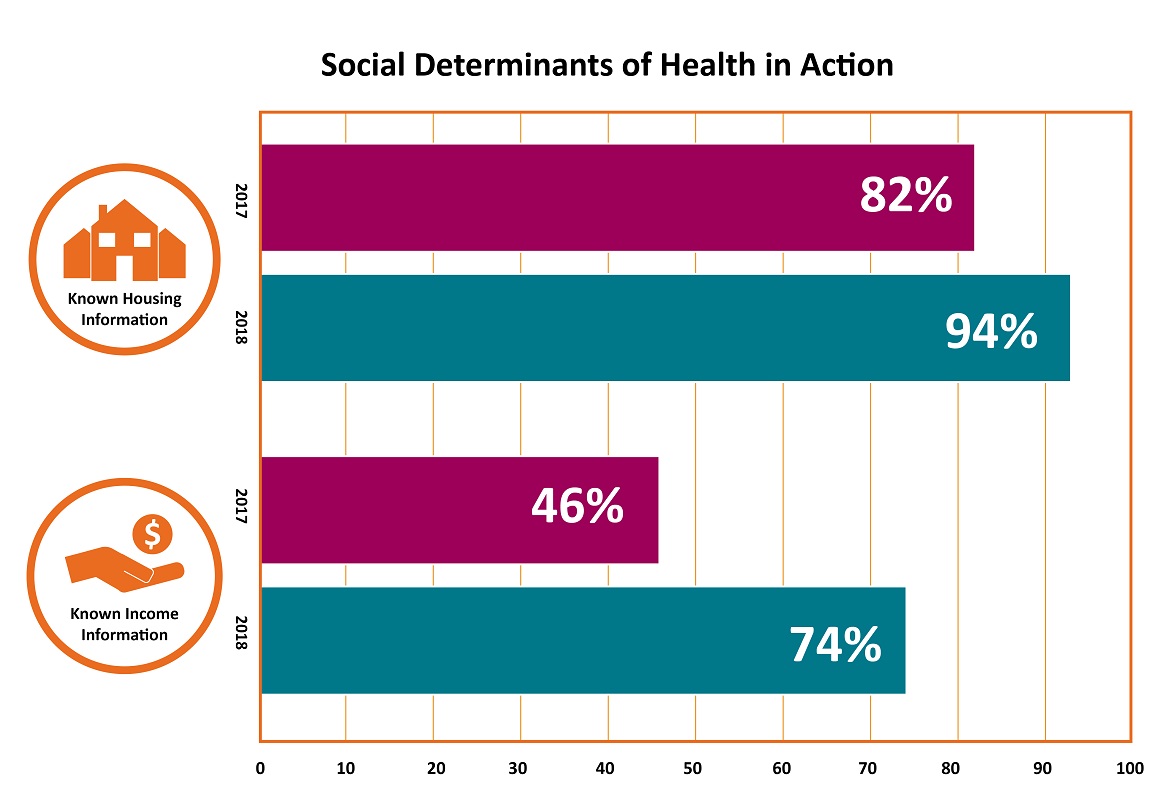
A few years ago, we started asking our clients about their lives outside our clinic walls, like their income and their access to food, health care and other necessities. Thanks to what we call Social Determinants of Health data, we can say, “Look, here’s the proof. Here’s the need.” Those numbers are having a powerful effect on how people and government agencies respond to homelessness.
Q: What have the data taught us about our clients?
We only had housing data on 82% of clients. Now, we know the housing situation for 94% of our clients. We also got income information for almost twice as many of our clients. What we’ve learned is that the people we serve are very low income—living 100% below the poverty line. That shows beyond a shadow of a doubt there is a huge need for our services.
More Recent News

We're excited to welcome Kisun Peters as Health Care for the Homeless' new Director of Finance. Kisun brings more than four years of finance leadership experience to this role, along with a commitment to expanding access to health care. Most recently, he served as Director of Finance & Business Development at Tuerk House, a behavioral health nonprofit in Baltimore. Read on to get to know Kisun better (and find out how he spent his summer)!
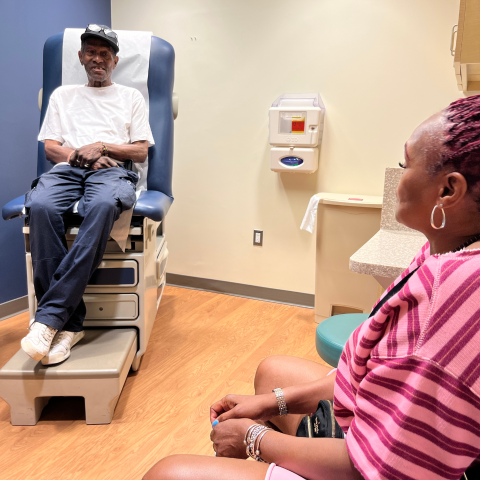
Spend a day with Patient Navigator Kim Taylor and see how hands-on support helps people experiencing homelessness navigate cancer screenings, treatment and a complex health care system. From coordinating referrals to sitting beside clients during appointments, Kim ensures no one faces a cancer diagnosis alone.
From their headquarters in East Baltimore, Moveable Feast designs and delivers thousands of healthy meals each week for people in Central Maryland and on the Eastern Shore (including some Health Care for the Homeless clients). Read about their approach to improving health through nutrition...

If you drive by the corner of Park, Liberty and Fayette, you'll notice some big changes. See how Sojourner Place at Park, our latest housing project in partnership with Episcopal Housing Corporation, is taking shape!