



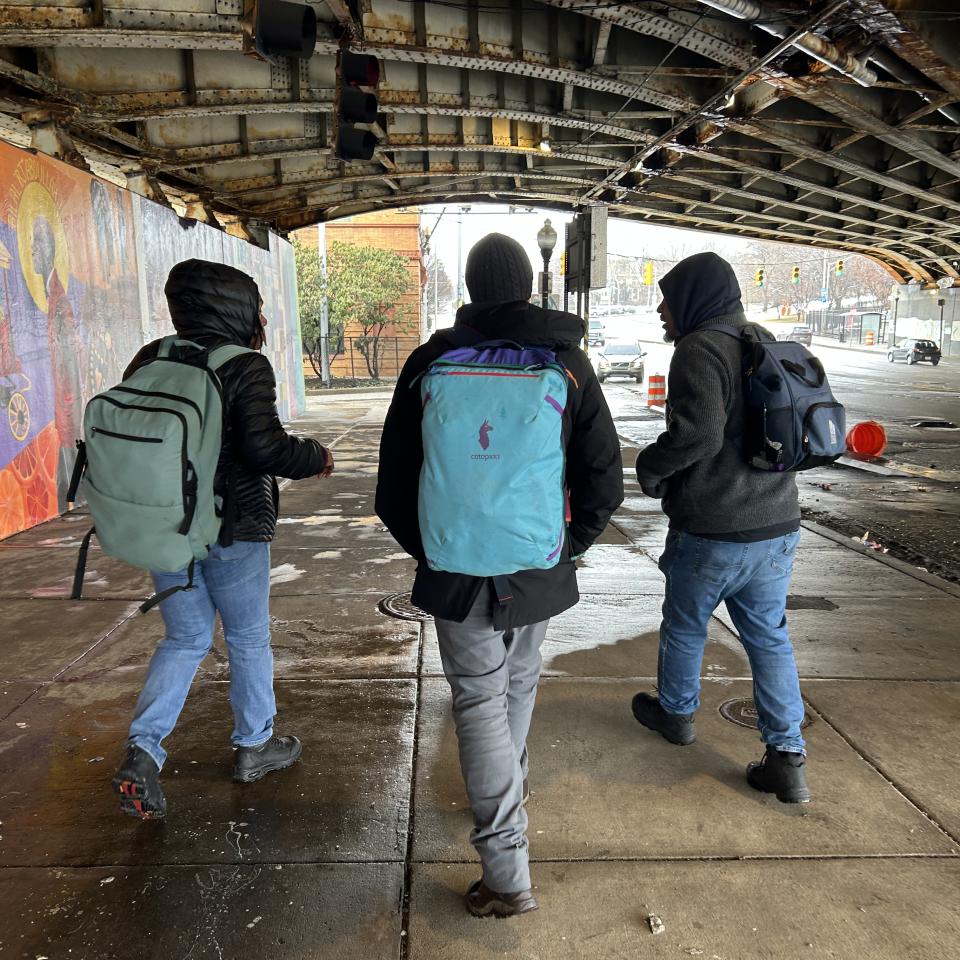
Day in the Life: Street Medicine
Health care doesn’t always happen in clinics. Spend the day with Baltimore’s Street Medicine Team as they take care to the tents, encampments and other places people live.
8:30 AM
The Street Medicine Team gathers on the first floor, in an office stuffed with supplies. Boxes overflow with tarps and masks. The program launched a year ago, designed to bring services directly to encampments and other places people stay.
Outreach Services Manager John Lane restocks a blue backpack with safer injection and safer sniffing kits. The kits include clean, sterile supplies that help people use drugs in ways that reduce the risk of infection and the spread of disease.
Development Associate Jaxon Evans arrives with a large bundle of survival kits—bags of food, socks, gloves and other supplies to make life a little easier for people living on the street.
Director of Outreach Services Jimmy Miller, MD, and Community Outreach Worker Justine Wright, CCHW, map out where the team will go this morning. Over the past year, they’ve marked places across the city and county where they’ve found people.
“The value of street medicine is the ability to connect with people in a space that is their own,” Jimmy says as he hoists a multicolored backpack with medical supplies. “As much as people do want care, they might not feel safe asking for it or they have other things that preoccupy their attention.”
9 AM
The team loads bags into a Health Care for the Homeless van and Justine drives off.
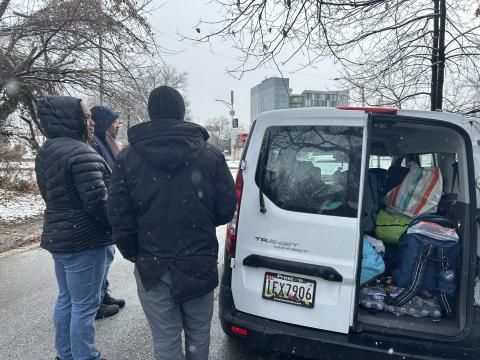
“We see a lot of folks who are staying in tents and ‘bandos’ (abandoned homes),” says John. “But we are still just scratching the surface.”
At an intersection in northwest Baltimore, they recognize a man in a black hat. Justine beeps the horn and rolls down her window. “Good morning, Rick!* How are you?”
Rick isn’t feeling up to a visit today. Jimmy gives an update on an appointment Rick asked for—our psychiatrist can see him Friday afternoon. Rick agrees.
John gestures at a young man at another intersection. Does Rick know him?
“Oh, that’s Mikey.* You should talk to him,” says Rick.
Word of mouth is a powerful tool for outreach. “A lot of clients will vouch for us,” says Justine. “When you show up consistently, people see that you keep your word.”
The team makes a U-turn and gives Mikey a wave. Justine explains that the group is from Health Care for the Homeless.
“My brother told me about you guys. You got him hooked up with food stamps. I want to get mine going again.
Somebody stole my card,” says Mikey.
“We can get you a replacement. Where are you staying?” asks John. Mikey and his brother are camping in the woods
in Baltimore County. When the wind chill dropped to negative degrees, they used a propane stove to stay warm.
John gives Mikey a backpack filled with supplies. The new backpack is just in time; his current one is falling apart.
10 AM
The team heads towards West Baltimore. “I see someone,” says John. They pull over and speak with JJ,* a young man with a dark beard who’s been living in a tent with a few friends.
JJ shares that he had to revive a friend who overdosed a few nights ago. “I used three rounds of Narcan (an opioid overdose reversal medication).” It was his girlfriend’s first time seeing how Narcan works, so it felt like an important, albeit harrowing, learning experience.
Jimmy gives JJ some more Narcan and asks about the wounds on his arms. “I’ve been using nonstick bandages and putting
some petroleum jelly around it,” says JJ. He agrees to show Jimmy his arms another time, when he is less bundled up.
JJ is also interested in signing up for food stamps. Justine plans to return tomorrow to help him complete the
paperwork.
The team hikes up a snowy hill to a small tent.
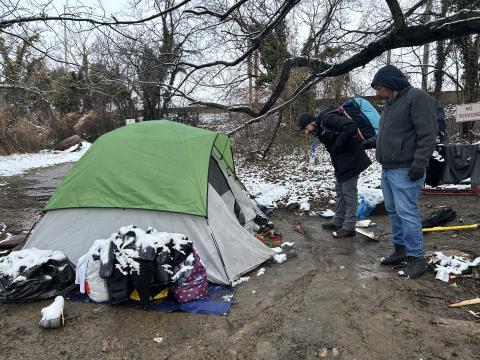
Alice* unzips her tent and talks to Jimmy. “I’m sick again.” It might be pneumonia. Jimmy encourages her to visit a hospital and get an x-ray to confirm. The team is hoping to get a portable ultrasound machine to make these kinds of diagnoses in the field in the future. Justine fishes some bus tokens out of her backpack and hands them to Alice.
Back in the van, Justine calls Jack,* a client they’ve been seeing for a few months. He is staying in a bando with his girlfriend, who is pregnant. The couple is up for a visit.
11:15 AM
A narrow fire escape leads from a cement parking pad to the third-floor window of a rowhome. A dark-haired man pokes his head out, waves and climbs down to the alley. Jack’s insurance has lapsed and now he can’t pick up his Suboxone prescription, used to treat opioid use disorder. Can the team help?
Justine calls our Benefits Enrollment team and hands the phone to Jack. After a few minutes, Jack is all set. Justine promises to deliver his insurance card when it arrives at the Fallsway clinic. “We’ve been doing this since the summer and have been able to help 10 people get their insurance reactivated,” says John.
Jack helps Alicia* down the fire escape. She is due to give birth in a few weeks. “How are you feeling?” asks Jimmy.
“Good,” says Alicia, taking out her phone. She smiles as she pulls up a picture of an ultrasound. “She has my nose and a lot of hair!”
The conversation turns to her upcoming prenatal appointments at Mercy Medical Center. Jimmy asks about life after the baby is born. Alicia shares that she’s found a local housing program where couples can live with their child while receiving substance use treatment. She’s already started the application.
In the van, John talks about a man the team has been seeing for a while. He never asks for anything, but John recently found out that he is a fan of old school R&B. John plans to bring him a radio.
Back at the clinic, the team discusses who Justine will visit that afternoon. Jimmy explains that visiting often is important. “If we don’t come by often enough, it creates pressure to get things done. We want it to be low pressure. You don’t have to do anything. We just want to get to know you.”
Justine turns on some music and records notes about the morning’s encounters, including which clients are interested in food assistance.
Federal changes to SNAP are making it harder for people to get food. Recipients must renew their benefits more often and provide more documentation. “People experiencing homelessness have other pressing issues and might not remember that their benefits are going to end.”
1 PM
Back on the road, Justine pulls into a gas station. Behind it, a green tarp draped over a tent twists in the chilly wind. Dean greets Justine and accepts her offer of some paracord to secure the tarp.
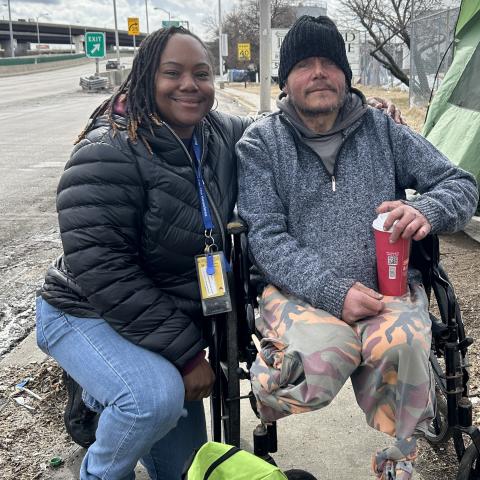
Dean used to own a construction company. He’s been living on the street for over a decade. "Me and my wife look at ourselves like we're homeless people's mother and father. They need help, they come to us.”
The team connected with Dean last year. “They helped me get on Suboxone,” he says. “It took me losing my legs to realize that I need to grow up. I'm not a kid no more.”
2 PM
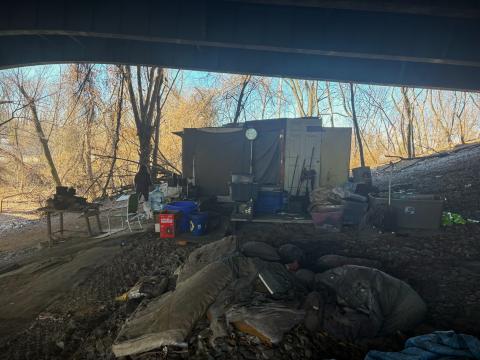
Justine drives past sprawling warehouses to the end of a road and hikes a short trail through the woods. There’s a small structure ahead, under a large bridge. “Mr. Ronald?* Are you home?”
Ronald’s tiny home is made out of doors and large wooden panels. A brown blanket covers the doorway. Ronald steps out and gives Justine an update on his neighbors—someone new is living in the woods nearby. Justine jots down a reminder to bring Ronald some batteries and hands him a bag of food and a few bottles of water.
3 PM
Next stop: a quiet sidewalk. Peter* is lying under a blanket. He has no tent. It’s 33 degrees and windy. Justine opens the back of the van and adds extra snacks to a survival kit. She crouches by Peter’s side and asks how he is doing. Peter says it’s cold, but he is ok. Is he interested in going into shelter? Peter shakes his head: not today. The team will be back tomorrow. As she drives away, Peter sits up and opens the bag of food.
“People are so appreciative of whatever you can offer,” says Justine. “Something as simple as a bottle of water can
give someone a little bit of relief.”
Near our downtown clinic, Justine hops out of the van and climbs up a grassy median. A few people were camping here last week. Now, there’s a square of light green grass where the tent used to be. “Probably got swept.” Justine shakes her head. Sweeps are traumatic. “People can lose ID, a birth certificate, a painting their child gave them that they’ve been holding onto since they got separated…”
Back at the clinic, Justine documents the afternoon’s encounters and sends messages to the medical records team. She flips through her binder of consent forms and benefits applications, making sure she has copies.
Tomorrow she’ll circle back to some of the same people and make new connections too. “I have faith in them,” she says.
*Pseudonym
More Recent News
Earlier this year, the Health Resources and Services Administration and the Bureau of Primary Health Care rolled out 2026 Community Health Quality Recognition Badges. Health Care for the Homeless received four badges
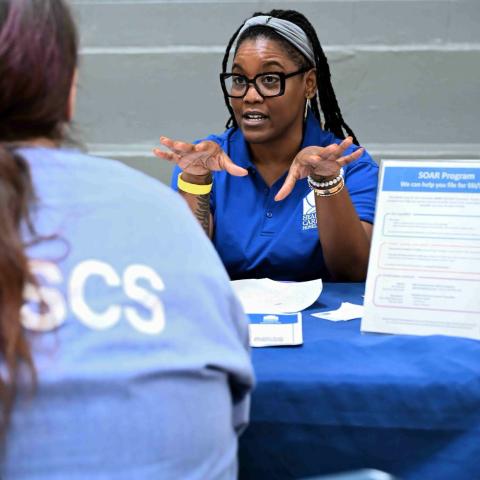
Preparing for reentry starts before release. Discover how Health Care for the Homeless staff are connecting with people behind prison walls, offering support and linking them to resources that can help make the transition home a little easier.

Major changes to Medicaid are coming, and Maryland estimates 175,000 people could lose their health coverage. For people experiencing homelessness, navigating new requirements and maintaining coverage can be especially hard. We talked with Nia Ballard of HealthCare Access Maryland (HCAM) about what’s changing, what she’s hearing from people across Maryland and why keeping people connected to health care matters.
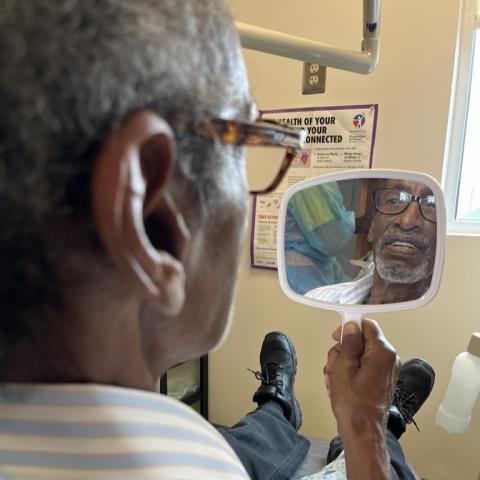
Spend the day with our Fallsway Dental Team and get a behind-the-scenes look at a busy day of cleanings, fillings, dentures and everything in between. Meet the dedicated staff helping clients access the treatment they need while building lasting relationships and healthier smiles.