




Saving lives—and giving life
We at Health Care for the Homeless seize every opportunity to educate and inform others about poverty and homelessness. And each year, the legislative session in Annapolis is fertile ground for that work, and for elevating the efforts underway every day in our community to—quite literally—change people’s lives. These efforts—and one little known program in particular—changed John’s.
After years of homelessness, including three years on the streets in front of our downtown clinic on Fallsway, John* has begun to regain control of his life. His story, recounted by Health Care for the Homeless staff at a recent budgetary session of the House of Delegates Appropriations Committee, underscores the impact of the SSI/SSDI Outreach, Access and Recovery (SOAR) program, which facilitates access to benefits for individuals experiencing homelessness who also have severe mental illness. SOAR is funded jointly by the federal government and the state of Maryland, and Health Care for the Homeless serves as a local lead for the program, providing fellow providers in the community with the training, education and technical assistance they need to expedite federal disability benefit application approvals and the overall federal disability benefits process for vulnerable individuals.
As one Health Care for the Homeless SOAR provider, Gerardo Benavides, puts it, “The individuals who need these benefits the most are sometimes those who are least able to access them.” For people experiencing homelessness, gaining access to disability income and other benefits is often the starting point in a return to a normal, healthy life.
John, during his long period of homelessness, struggled mightily to engage with care, because his mental illness made daily functioning and communication nearly impossible. This, compounded by the other many challenges and dangers of life on the streets, often had him turning to “spice” as a coping mechanism. His abuse of the drug led to frequent overdoses—and during some stretches he was hospitalized almost daily.
John was able to get back on a track toward health and safety, with the persistence of providers including Nate Thomas. As a Peer Advocate, Thomas engages with John on his own terms, working alongside John to navigate and educate him through his entire network of care. With patient support from Thomas and others, John received health care at Health Care for the Homeless, and he gained access to disability benefits through SOAR.
SOAR opened up all kinds of opportunities for John. Because his mental illness made him vulnerable on the streets, John’s SOAR specialist enrolled him in a pilot housing project here that connects SOAR-eligible clients with housing, and with ongoing care from providers that will stay by John as he transitions to a new life.
John has made big strides. “After he was housed, he stopped abusing drugs without any drug treatment,” Thomas says. And his struggle with incontinence, which plagued him during his time on the streets, has subsided.
Thomas can’t say enough about what SOAR has made possible for John: “With housing, we didn’t just save this client’s life. We gave him life.”
*John is not this client’s real name.
More Recent News

We're excited to welcome Kisun Peters as Health Care for the Homeless' new Director of Finance. Kisun brings more than four years of finance leadership experience to this role, along with a commitment to expanding access to health care. Most recently, he served as Director of Finance & Business Development at Tuerk House, a behavioral health nonprofit in Baltimore. Read on to get to know Kisun better (and find out how he spent his summer)!
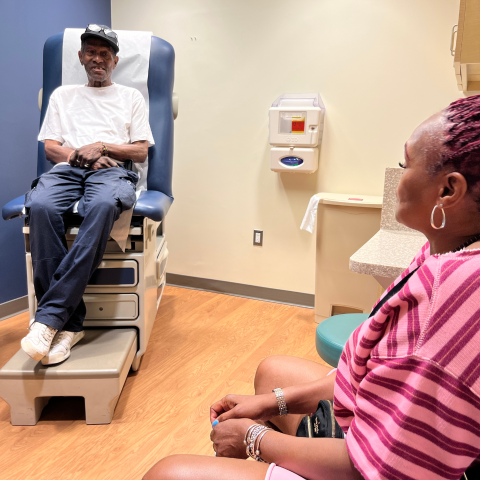
Spend a day with Patient Navigator Kim Taylor and see how hands-on support helps people experiencing homelessness navigate cancer screenings, treatment and a complex health care system. From coordinating referrals to sitting beside clients during appointments, Kim ensures no one faces a cancer diagnosis alone.
From their headquarters in East Baltimore, Moveable Feast designs and delivers thousands of healthy meals each week for people in Central Maryland and on the Eastern Shore (including some Health Care for the Homeless clients). Read about their approach to improving health through nutrition...

If you drive by the corner of Park, Liberty and Fayette, you'll notice some big changes. See how Sojourner Place at Park, our latest housing project in partnership with Episcopal Housing Corporation, is taking shape!