



Housing not handcuffs
As homelessness increases across the country, some communities are jailing or fining unhoused people for sleeping in public. The Trump administration has proposed forcing unhoused people into government-run detention camps. To set the record straight on what works to solve homelessness, we spoke with Sr. Policy Director Eric Tars from the National Homelessness Law Center.
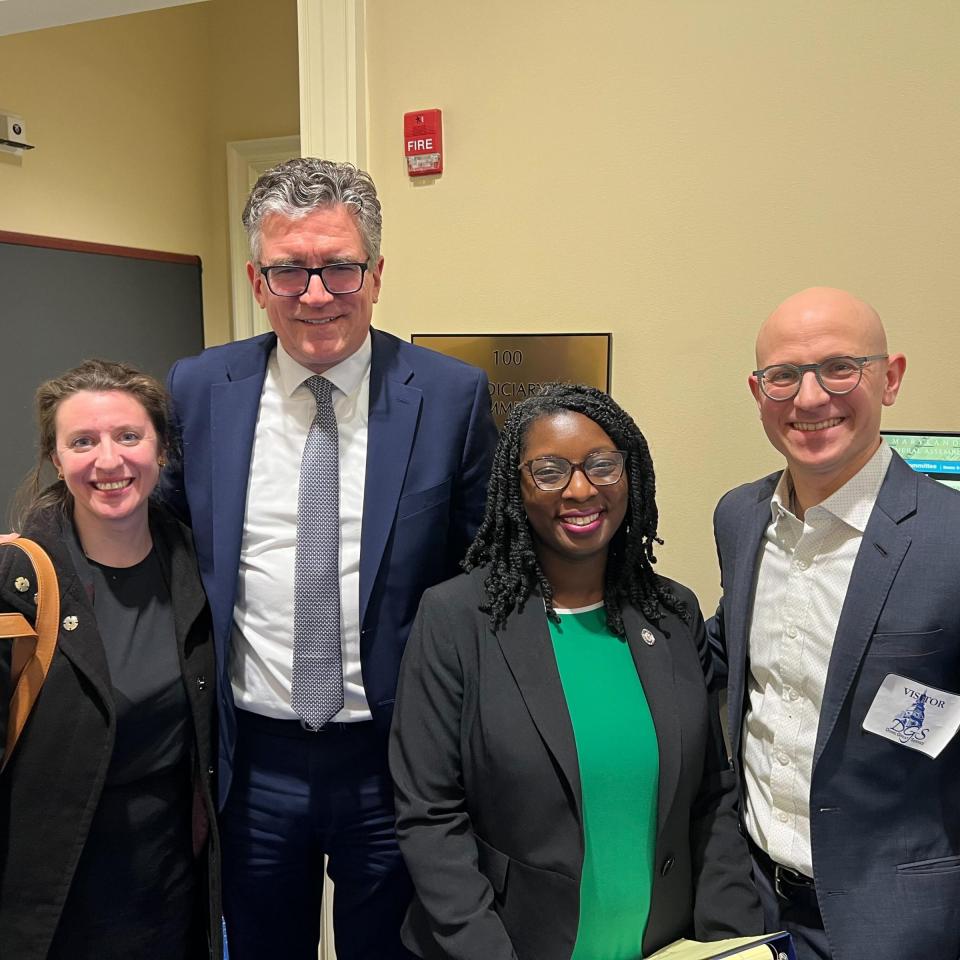
Pictured above: NHLC Sr. Policy Director Eric Tars (right) with Delegate Bernice Mireku-North with Health Care for the Homeless President & CEO Kevin Lindamood and Policy Director Joanna Diamond after testifying in favor of HB487.
What was the Johnson v. Grants Pass decision, and how is the Law Center responding in Maryland?
Last year, the Supreme Court ruled that cities can arrest or fine people for sleeping outside—even when they have nowhere else to go. Since this shameful ruling, over 150 cities have passed laws that make it illegal to be homeless.
In response, we created template language that states can use to restore the rights of homeless residents. While the Maryland bill (HB 487) did not pass, we advocated strongly to restore those lost protections and are excited to work with state and local partners next year to pass this common sense law.
Why are some cities jailing people for sleeping outside?
Everybody needs a safe place to live, and nobody wants to see people sleeping outside. The best thing to do is to get people back into housing. But the most politically convenient thing, unfortunately, is to use law enforcement to force people out of public view. It allows elected officials to say, “I’ve done something about homelessness,” and they can hide the cost in the police budget and jail budget. But it actually costs 2-3X more to run a person through the jail system.
In addition to cost, you haven’t solved that person’s homelessness. Cities are spending tens of millions of dollars shuffling people from corner to corner while pushing people further into homelessness and poverty.
Can you share some examples of what works instead?
If our collective goal is to end homelessness, we need to focus on what works: investing in housing and supports.
In 1991, for example, Miami set a standard that you can’t arrest someone for sleeping outside unless you give them an alternative. They redirected tax dollars to housing that people could afford and created more shelter beds, and in doing so, cut their homelessness rates by more than half. When that injunction was removed, Miami returned to jails and fines, and homeless rates increased.
Nationally, we have seen the number of veterans experiencing homelessness go way down. That’s a direct result of outreach and housing. It’s not by arresting veterans.
What other trends are you seeing nationally?
Rents are going up everywhere. Zillow has found that for every $100 increase in rent, homelessness goes up by 9%. Lack of affordable housing is the leading driver of homelessness.
In addition to Maryland, at least eight other states introduced legislation to stop cities from arresting and ticketing people for sleeping outside. Resolutions have already passed in Philadelphia and Hampden, Connecticut. And we are working with congressional champions to introduce legislation in Congress that would prevent federal law officers from enforcing anti-homeless laws when people have nowhere else to go.
What’s one way readers can take action?
Join the Housing not Handcuffs Campaign at housingnothandcuffs.org.
More Recent News

We're excited to welcome Kisun Peters as Health Care for the Homeless' new Director of Finance. Kisun brings more than four years of finance leadership experience to this role, along with a commitment to expanding access to health care. Most recently, he served as Director of Finance & Business Development at Tuerk House, a behavioral health nonprofit in Baltimore. Read on to get to know Kisun better (and find out how he spent his summer)!

Spend a day with Patient Navigator Kim Taylor and see how hands-on support helps people experiencing homelessness navigate cancer screenings, treatment and a complex health care system. From coordinating referrals to sitting beside clients during appointments, Kim ensures no one faces a cancer diagnosis alone.
From their headquarters in East Baltimore, Moveable Feast designs and delivers thousands of healthy meals each week for people in Central Maryland and on the Eastern Shore (including some Health Care for the Homeless clients). Read about their approach to improving health through nutrition...

If you drive by the corner of Park, Liberty and Fayette, you'll notice some big changes. See how Sojourner Place at Park, our latest housing project in partnership with Episcopal Housing Corporation, is taking shape!